

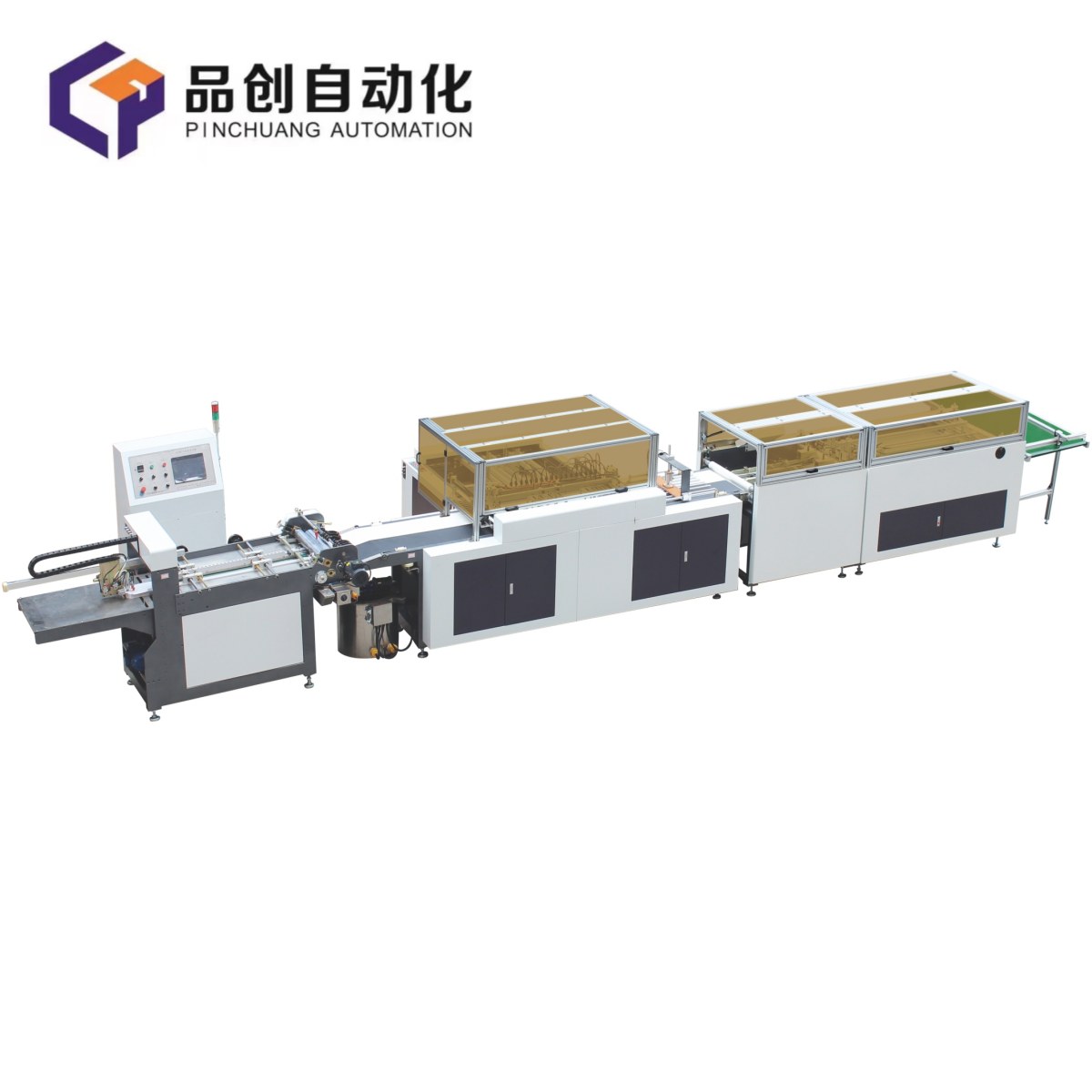
An automatic case making machine glues a printed cover paper to greyboard and wraps the edges to produce a flat, finished case — the cover of a hardback book, a desk calendar, a photo album or a ring binder, and also the printed face paper on the lid of a rigid box. It produces a flat panel, not a three-dimensional box, and that single fact explains almost everything about who buys one.
At Pinchuang, we build both case making and rigid box equipment, so we are usually asked to explain the difference by customers who assume the two machines compete. They do not. This guide explains what an automatic case making machine actually produces, how it differs from a rigid box line, the five checks that matter before you buy, and where case making fits inside a box making operation.
What an Automatic Case Making Machine Actually Does
The process runs in four steps, and every automatic case making machine on the market follows the same sequence.
- Cover paper is fed from a stack and glued. Glue film has to be even across the whole sheet, because the paper is being bonded to a rigid board rather than folded around a product.
- Greyboard pieces are placed on the glued paper. A case usually uses two or three boards — front, back and a spine strip — with a gap between them that becomes the hinge.
- The paper edges are turned in and pressed around all four sides of the board assembly.
- The finished case is pressed and delivered flat. It is now a cover waiting for a book block, or a wrapped panel waiting to be formed into a box.
That is the whole machine. Note what is missing: there is no forming station, because on this type of automatic case making machine the output stays flat by design. Turning that flat case into a box is the job of a different machine, which is why the two live happily in the same factory.
On our case making platform the working range starts at small covers around L 150 × W 90 mm and reaches L 1000 × W 500 mm, with greyboard from 1 mm to 4 mm and cover paper from 100 to 250 g/m². Published output on the standard configuration is 20–30 sheets/min, and positioning precision is quoted at ±0.50 mm for mechanical referencing.
Case Making vs Rigid Box Making: Same Craft, Different Output
Both processes glue paper to board and turn the edges in. That is where the similarity ends, and the differences are the reason a plant may need both machines rather than choosing between them.
| Point | Case making | Rigid box making |
|---|---|---|
| Output shape | Flat wrapped panel | Three-dimensional box |
| Key stations | Gluing, board placing, edge turning, pressing | Gluing, V-grooving, corner pasting, wrapping, forming |
| Typical output | Book covers, calendars, albums, folders, box wraps | Jewellery, watch, cosmetics, spirit and gift boxes |
| Typical buyer | Bookbinders, print finishers, stationery plants | Packaging plants, gift box producers |
| Board gap | Spine gap is part of the product | No spine; corners carry the load |
The spine gap is the detail that trips up buyers new to case making. On a book cover, the two boards must be separated by a gap that lets the case hinge open, and that gap has to be consistent or the book will not lie flat. On our platform the minimum middle strip is 10 mm, and a case making machine can handle up to six separated board pieces in one assembly. Neither of those settings exists on a rigid box making machine, because a box has no spine.
When a Case Making Machine Earns Its Place
A case making machine pays for itself in five situations. If none of them describes your order book, you probably do not need one yet.
- Hardback book covers. This is the classic case making job, and volume comes from publishers and print finishers rather than from packaging.
- Desk and wall calendars. Calendar covers are stiff boards with a wrap and a printed face, produced in seasonal peaks that reward a machine with fast setup.
- Photo albums and premium stationery. Album covers and high-end folders use the same construction as a book case, often with a heavier decorative wrap.
- Box lids and box wraps. Many gift box producers run a case making machine to prepare the printed face panel before it goes onto a forming line. On that route, case making is a feeder station, not a competitor.
- Ring binders and clip folders. A steady, unglamorous product with reliable repeat volume and a fixed construction that suits automation.
If your work is short-run and highly customised, a bench and a skilled operator will still beat a machine. Case making rewards products whose construction never changes — which is exactly why books and calendars are its home ground.
What to Check Before Buying
Five specification points decide whether a machine fits your product, and each one is easier to check against a sample than against a brochure.
1. Case size range
Check both ends against your smallest and largest product, not the range midpoint. A machine that quotes a maximum of 1000 × 500 mm may still be awkward at that size if the paper feed and turn-in units are tuned for smaller work.
2. Board thickness and board count
Board thickness on our platform runs from 1 mm to 4 mm, and the number of separated board pieces per case goes up to six. If your construction uses a narrow spine strip, confirm the minimum middle strip — 10 mm on our machines — before you commit.
3. Cover paper weight
The standard case making range covers 100–250 g/m², while the configurations fitted with Yamaha visual positioning reach 80–300 g/m². Heavier decorative wraps and laminated papers need different glue settings, and very light papers tear more easily during turn-in.
4. Glue control
Case making applies glue across a large flat sheet, so an even film matters even more than it does on a small box. A dedicated paper gluing machine is often the difference between a case that lies flat and one that curls at the edges after a week in a warehouse.
5. Positioning method
Mechanical referencing is fine for plain covers and holds around ±0.50 mm. If the cover carries a printed pattern that must sit centred — a logo, a border, a design that wraps around the spine — a visual positioning unit reads printed marks and corrects the position before gluing. Our Yamaha-equipped configuration holds ±0.1 mm, which is the difference between a cover that looks printed-to-fit and one that looks almost right.
Case Making Inside a Rigid Box Line
Where a factory makes both books and boxes, case making is not a separate business — it is an upstream station. The flat case it produces becomes the wrapped face of a rigid box, and the forming line downstream turns it into the finished product. That is why we build a combined configuration, the PC-5010D, which handles rigid box and hardcover production on one platform for plants that genuinely need both.
For scale reference, Pinchuang builds this equipment in a 10,000 m² facility in Dongguan with more than 100 employees, and the machines ship to over 30 countries. We have been manufacturing case making and box making equipment since 2008, and we exhibit at All in Print China, Printing South China, China Print, Drupa, SINO FOLDING CARTON and WEPACK.


If you are not sure which end of the range your work sits at, the quickest test is to send two extreme samples — your largest cover and your smallest — rather than a single typical one. Looking at the applications we see most often will also tell you quickly whether your product mix looks like a case making job or a box making job.
Common Questions About Case Making
Can a case making machine make rigid boxes?
No. It produces a flat wrapped case, which is one component of a box rather than the finished product. To turn that flat case into a box you need a forming station and, on most constructions, V-grooving and corner pasting as well. The two processes are complementary, not interchangeable.
What is the minimum gap between boards?
On our case making platform the minimum middle strip is 10 mm. This gap becomes the hinge on a book cover, so it has to be consistent along the whole spine; a gap that varies will show as a case that opens unevenly or refuses to lie flat on a shelf.
Do I need visual positioning for case making?
Only if the cover carries a printed design that must land in a specific place. Plain covers, solid colours and simple textures can be located mechanically and hold around ±0.50 mm. Logos, borders and spine designs that must line up benefit from the ±0.1 mm achievable with a Yamaha visual positioning unit.
Why do my finished covers curl at the edges?
Almost always glue or moisture rather than the wrapping itself. An uneven glue film, or a paper that absorbs moisture differently from the board, will pull the edges out of flat as the case equalises with the room. Check glue film first, then storage conditions, before adjusting the machine.
Send Pinchuang your largest and smallest cover, your board thickness and your cover paper weight. We will tell you which automatic case making machine covers your range, and whether your glue control needs attention first.
Send us two cover samples Compare all case making models